Ffynnon Fair (ffynnon is Welsh for fountain or well, and Fair is the lenited form of Mair, Mary) is another of R.S.Thomas’s more serene poems, like ‘Llananno’ (see week 358), that I find particularly satisfying. I am not sure how literally he means ‘the pure spirit/that lives there’, but as with many of Thomas’s poems, I don’t think you have to share the poet’s religious faith to appreciate them. Whether or not you believe in a Creator, and if you do you may well think that He did a particularly neat job with water, it seems entirely proper to me to have a reverence for this niraculous life-giving substance with its remarkable chemistry.
Coincidentally I have just been reading an excellent book by Amy-Jane Beer called ‘The Flow’, a celebration of Britain’s rivers, rich in both poetry and facts, and somewhat reminiscent of Roger Deakin’s classic ‘Waterlog’ (see week 437). It is sad the way our waterways are treated now: if only those with the power over them had something of these writers’ reverence to match.
Ffynnon Fair (St Mary’s Well)
They did not divine it, but they bequeathed it to us: clear water, brackish at times, complicated by the white frosts of the sea, but thawing quickly.
Ignoring my image, I peer down to the quiet roots of it, where the coins lie, the tarnished offerings of the people to the pure spirit that lives there, that has lived there always, giving itself up to the thirsty, withholding itself from the superstition of others, who ask for more.
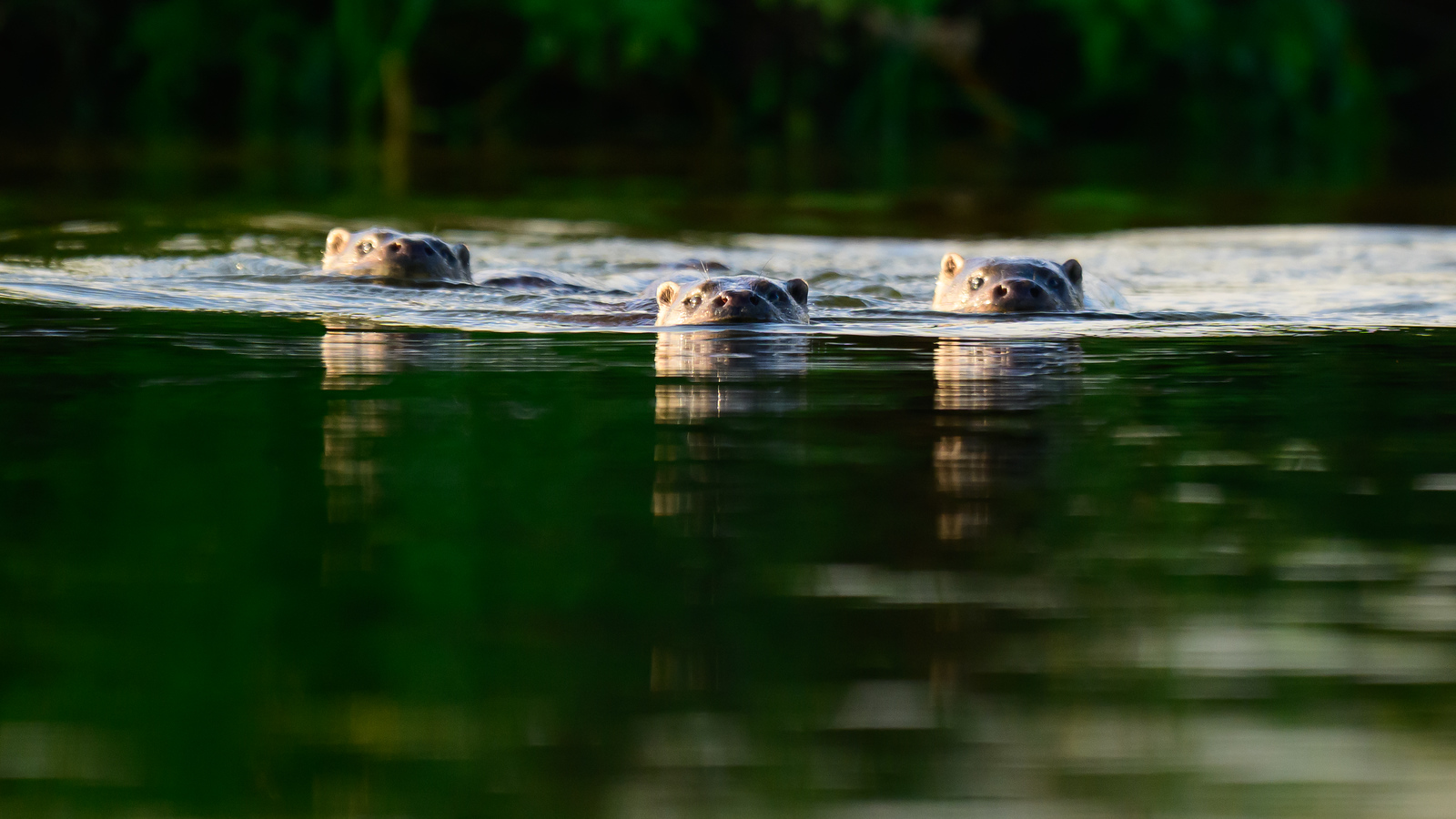
Today another Ted Hughes poem, ‘An Otter’, which first appeared in his 1960 collection ‘Lupercal’. Otters have been making a comeback recently in the Thames quite near my home, and this week as a bonus I am, by kind permission of our local wildlife photographer Simon Booker, including a photo of three otters that he recently took in the Thames near his home at South Stoke. It’s a remarkable photograph, though I must confess that at first glance I took the otters for three hippopotami. Simon assures me that this is a very easy mistake to make, if one discounts the couple of tons difference in bodyweight and the fact that despite global warming hippopotami have yet to make an appearance in the Thames.
As far as the poem goes, I think it does a good job of capturing the otherness of the otter, a creature that is neither wholly of water nor of land, and as usual with Ted Hughes it has some fine descriptive touches: I particularly like ‘crying to the old shape of the starlit land’. But for me it lacks the sustained power of Hughes’s ‘Pike’ (see week 553), flagging a bit in the last three stanzas, and I feel it could have benefited from some compression.
An Otter
Underwater eyes, an eel’s Oil of water body, neither fish nor beast is the otter: Four-legged yet water-gifted, to outfish fish; With webbed feet and long ruddering tail And a round head like an old tomcat.
Brings the legend of himself From before wars or burials, in spite of hounds and vermin-poles; Does not take root like the badger. Wanders, cries; Gallops along land he no longer belongs to; Re-enters the water by melting.
Of neither water nor land. Seeking Some world lost when first he dived, that he cannot come at since, Takes his changed body into the holes of lakes; As if blind, cleaves the stream’s push till he licks The pebbles of the source; from sea
To sea crosses in three nights Like a king in hiding. Crying to the old shape of the starlit land, Over sunken farms where the bats go round, Without answer. Till light and birdsong come Walloping up roads with the milk wagon.
The hunt’s lost him. Pads on mud, Among sedges, nostrils a surface bead, The otter remains, hours. The air, Circling the globe, tainted and necessary,
Mingling tobacco-smoke, hounds and parsley, Comes carefully to the sunk lungs. So the self under the eye lies, Attendant and withdrawn. The otter belongs
In double robbery and concealment — From water that nourishes and drowns, and from land That gave him his length and the mouth of the hound. He keeps fat in the limpid integument
Reflections live on. The heart beats thick, Big trout muscle out of the dead cold; Blood is the belly of logic; he will lick The fishbone bare. And can take stolen hold
On a bitch otter in a field full Of nervous horses, but linger nowhere. Yanked above hounds, reverts to nothing at all, To this long pelt over the back of a chair.
Remembrance Sunday comes round again, and this week I offer one of my own poems on the subject. Not being born until 1944 I have, of course, no memory of the Second World War, let alone the First, but my mother who was born in 1908 told me stories of both, and this one, of a young soldier who was billeted with her family for a while before being sent out to the trenches in the Great War, haunted me for years until I finally made what offering I could to his shade.
Remembering Dido
They never came back, the young men Billeted with my grandmother in the Great War At 40, Church Road, Watford on their way to the Front. My mother forgot their names, she was only six And they were too many. One, though, she remembered: Dido, they called him, who was handsome and merry-hearted, Who called her Pinky, who teased her about her dolls, Who tossed her up to the ceiling and caught her again In strong young cricketer’s arms; who died, they heard, Bullet-riddled, throwing grenades, running forward Cheering the others on, like a boy at play. My mother was the last, I think, who knew him, And she is dead now too. His name was Dido.