Today another Ted Hughes poem, ‘An Otter’, which first appeared in his 1960 collection ‘Lupercal’. Otters have been making a comeback recently in the Thames quite near my home, and this week as a bonus I am, by kind permission of our local wildlife photographer Simon Booker, including a photo of three otters that he recently took in the Thames near his home at South Stoke. It’s a remarkable photograph, though I must confess that at first glance I took the otters for three hippopotami. Simon assures me that this is a very easy mistake to make, if one discounts the couple of tons difference in bodyweight and the fact that despite global warming hippopotami have yet to make an appearance in the Thames.
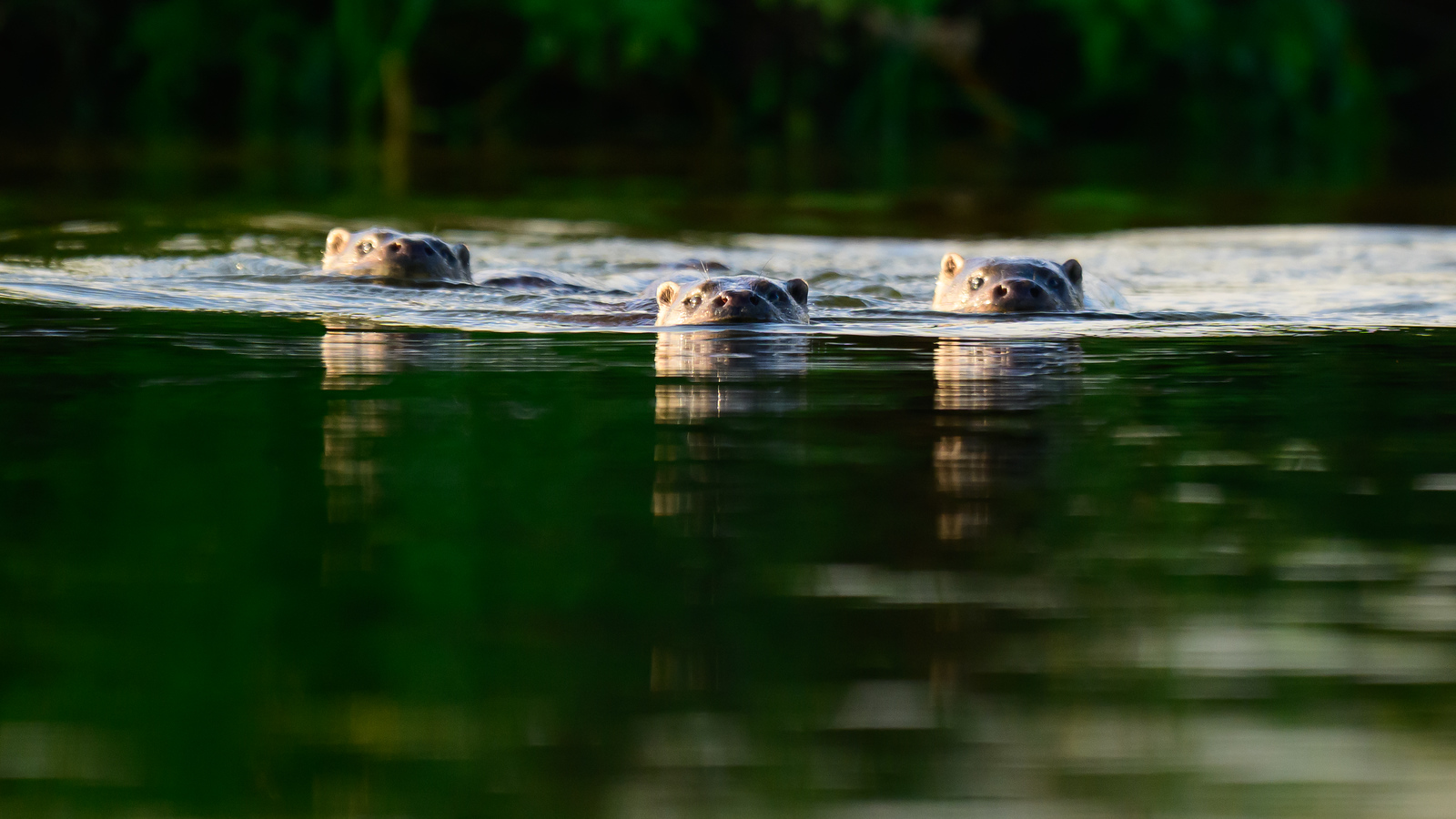
A larger and higher resolution copy of this photograph, along with many other otter photographs, is available for purchase at https://www.stokerpix.com/Galleries/Animals/Otter
Simon also does a beautiful wildlife calendar; see https://stokerpix.square.site/product/stokerpix-2027-charity-calendar/3
As far as the poem goes, I think it does a good job of capturing the otherness of the otter, a creature that is neither wholly of water nor of land, and as usual with Ted Hughes it has some fine descriptive touches: I particularly like ‘crying to the old shape of the starlit land’. But for me it lacks the sustained power of Hughes’s ‘Pike’ (see week 553), flagging a bit in the last three stanzas, and I feel it could have benefited from some compression.
An Otter
Underwater eyes, an eel’s
Oil of water body, neither fish nor beast is the otter:
Four-legged yet water-gifted, to outfish fish;
With webbed feet and long ruddering tail
And a round head like an old tomcat.
Brings the legend of himself
From before wars or burials, in spite of hounds and vermin-poles;
Does not take root like the badger. Wanders, cries;
Gallops along land he no longer belongs to;
Re-enters the water by melting.
Of neither water nor land. Seeking
Some world lost when first he dived, that he cannot come at since,
Takes his changed body into the holes of lakes;
As if blind, cleaves the stream’s push till he licks
The pebbles of the source; from sea
To sea crosses in three nights
Like a king in hiding.
Crying to the old shape of the starlit land,
Over sunken farms where the bats go round,
Without answer. Till light and birdsong come
Walloping up roads with the milk wagon.
The hunt’s lost him. Pads on mud,
Among sedges, nostrils a surface bead,
The otter remains, hours. The air,
Circling the globe, tainted and necessary,
Mingling tobacco-smoke, hounds and parsley,
Comes carefully to the sunk lungs.
So the self under the eye lies,
Attendant and withdrawn. The otter belongs
In double robbery and concealment —
From water that nourishes and drowns, and from land
That gave him his length and the mouth of the hound.
He keeps fat in the limpid integument
Reflections live on. The heart beats thick,
Big trout muscle out of the dead cold;
Blood is the belly of logic; he will lick
The fishbone bare. And can take stolen hold
On a bitch otter in a field full
Of nervous horses, but linger nowhere.
Yanked above hounds, reverts to nothing at all,
To this long pelt over the back of a chair.
Ted Hughes

