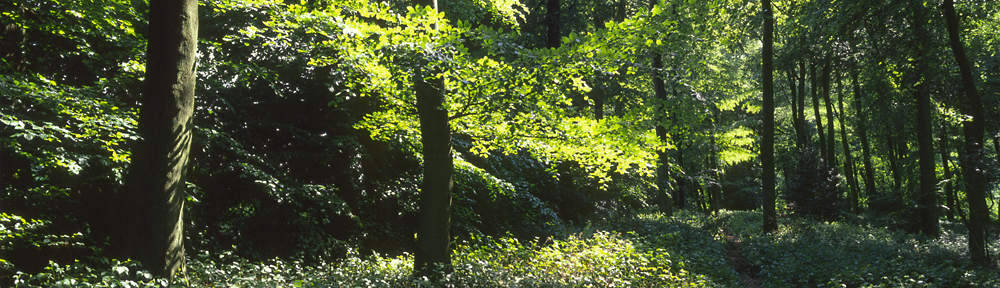
‘The Other’ is one of Edward Thomas’s earliest poems, written towards the end of 1914, and also one of his longest, about his sense of there always being a doppelganger or alter ego somewhere ahead of him that he can never quite catch up with. I don’t think that the poem as a whole quite comes off: it is a little prolix and uncertain, as if the poet himself is not sure what he is trying to say, and later his poems would become much more distilled. But as usual with Thomas it has some fine lyrical touches, especially in its evocation of a wild twilight in stanzas seven and eight.
Edward Thomas came my way once, in the summer of 1911, when he was researching material for one of his commissioned books on the countryside, ‘The Icknield Way’, making forays on foot or by bicycle along the length of the ancient trackway. On the day in question he had come down from Edlesborough in the north, following the course of the Way by lane and footpath through Wendover, Swyncombe, Ewelme and across Grim’s Ditch, until about evening he passed by Ipsden with its ‘little, solitary church’, continued down a rough road that dwindled to a footpath, and turned west to follow ‘a hard and hedgeless road, winding and undulating through corn that rises on either side to a crested ridge’. He crossed the Woodcote-Crowmarsh road (I guess at the turn out from Braziers Park), came along by Ivol Barn, across the crossroads at the foot of South Stoke Road, up Catsbrain Hill and so saw before him ‘the red roofs and walls of suburban Cleeve, and the Berkshire downs’. For some reason Edward did not take to Cleeve at all, which I have always thought a rather pleasant place with its tree-lined roads. Perhaps it was the end of a long day, and he was tired and far from home, but for whatever reason it triggered in him one of those fits of melancholy that characterised his temperament, and he let fly with a diatribe against the ‘blocks of redbrick houses’, wondering how people could bear to live in so spiritless a place.
Now I know that section of road over the upland to Cleeve intimately, since it forms part of one of my standard 10K loops from home, that I have run a hundred times, on harvest evenings, in winter moonlight. Sometimes, as twilight comes down over the ploughland, I have seen in my mind’s eye that figure in front of me on his lonely road, bitter with knowledge of the wasted power within him, and I have wished that time could be different, that one could go back and tell him that now, an unimaginable century on, he is where he would have wished to be, secure in his honour among the English poets. But of course, the future can say nothing to the past.
The Other
The forest ended. Glad I was
To feel the light, and hear the hum
Of bees, and smell the drying grass
And the sweet mint, because I had come
To an end of forest, and because
Here was both road and inn, the sum
Of what’s not forest. But ‘twas here
They asked me if I did not pass
Yesterday this way. ‘Not you? Queer.’
‘Who then? and slept here?’ I felt fear.
I learnt his road and, ere they were
Sure I was I, left the dark wood
Behind, kestrel and woodpecker,
The inn in the sun, the happy mood
When first I tasted sunlight there.
I travelled fast, in hopes I should.
Outrun that other. What to do
When caught, I planned not. I pursued
To prove the likeness, and, if true,
To watch until myself I knew.
I tried the inns that evening
Of a long gabled high-street grey,
Of courts and outskirts, travelling
An eager but a weary way,
In vain. He was not there. Nothing
Told me that ever till that day
Had one like me entered those doors,
Save once. That time I dared: ‘You may
Recall; – but never-foamless shores
Make better friends than those dull boors.
Many and many a day like this
Aimed at the unseen moving goal
ttAnd nothing found but remedies
For all desire. These made not whole;
They sowed a new desire, to kiss
Desire’s self beyond control,
Desire of desire. And yet
Life stayed on within my soul.
One night in sheltering from the wet
I quite forgot I could forget.
A customer, then the landlady
Stared at me. With a kind of smile
They hesitated awkwardly:
Their silence gave me time for guile.
Had anyone called there like me,
I asked. It was quite plain the wile
Succeeded. For they poured out all.
And that was naught. Less than a mile
Beyond the inn, I could recall
He was like me in general.
He had pleased them, but I less.
I was more eager than before
To find him out and to confess,
To bore him and to let him bore.
I could not wait: children might guess
I had a purpose, something more
That made an answer indiscreet.
One girl’s caution made me sore,
Too indignant even to greet
That other had we chanced to meet.
I sought then in solitude.
The wind had fallen with the night; as still
The roads lay as the ploughland rude,
Dark and naked, on the hill.
Had there been ever any feud
‘Twixt earth and sky, a mighty will
Closed it: the crocketed dark trees,
A dark house, dark impossible
Cloud-towers, one star, one lamp, one peace
Held on an everlasting lease:
And all was earth’s, or all was sky’s;
No difference endured between
The two. A dog barked on a hidden rise;
A marshbird whistled high unseen;
The latest waking blackbird’s cries
Perished upon the silence keen.
The last light filled a narrow firth
Among the clouds. I stood serene,
And with a solemn quiet mirth,
An old inhabitant of earth.
Once the name I gave to hours
Like this was melancholy, when
It was not happiness and powers
Coming like exiles home again,
And weaknesses quitting their bowers,
Smiled and enjoyed, far off from men,
Moments of everlastingness.
And fortunate my search was then
While what I sought, nevertheless,
That I was seeking, I did not guess.
That time was brief: once more at inn
And upon road I sought my man
Till once amid a tap-room’s din
Loudly he asked for me, began
To speak, as if it had been a sin,
Of how I thought and dreamed and ran
After him thus, day after day:
He lived as one under a ban
For this: what had I got to say?
I said nothing. I slipped away.
And now I dare not follow after
Too close. I try to keep in sight,
Dreading his frown and worse his laughter.
I steal out of the wood to light;
I see the swift shoot from the rafter
By the inn door: ere I alight
I wait and hear the starlings wheeze
And nibble like ducks: I wait his flight.
He goes: I follow: no release
Until he ceases. Then I also shall cease.
Edward Thomas